Would you like to add
your Club or Organization to the list below?
Send me an email with your information
to rcmedic@zianet.com
I have place some interesting information and definitions that I have found on the internet near the bottom of the page. Check it out. It is interesting to me how some people perceive others.
| Rider
Clubs and Information Sites | |
| WWW.NMXRIDERS.COM | |
| New Mexico American Legion Riders Motorcycle association — State | |
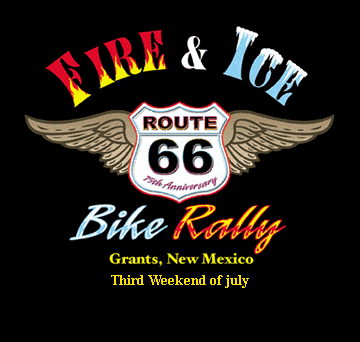 | |
| 2nd Annual Las Cruces BIKE SHOW February 10th, & 11th | |
 Another NM Motorcycle Rally, Run, and/or Events Calendar Page | |
| New Mexico State Motorcycle Runs and Rallies | |
| Southwest Bike Travel-Zine | |
| Riders of Kawasaki ---->"ROK" | |
| Vulcan Owners and Riders Club (VROC) | |
| Willville
Motorcycle Campground MOTORCYCLES ONLY | |
| V-Twin
Mama Website for Women Riders | |
 | |
| Cycle
Highway Motorcycle Information | |
 | |
 | |
|
| |
| Music Video "Unknown Legend"
By Neil Young Codes By Music Jesus.com | |
Motorcycle club
From Wikipedia, the free encyclopedia
This article
is about "American-style" motorcycle clubs (MCs) as a specific cultural
phenomenon, not motorcycle riding clubs in the generic sense of the term.
A Motorcycle Club (MC) is an organized club of motorcycle riders who follow a series of traditional rules for participation in the club, including, but not limited to, a group of elected officers; a probationary period for new members; the wearing of a specific club patch (or patches) adorned with the term "MC"; a measure of privacy about their internal structure, bylaws, and membership; and some level of sworn allegiance to other members of the club.
The typical internal organization of a motorcycle club consists of a president, vice president, treasurer, secretary, road captain, and sergeant-at-arms. Localized groups of a single, large MC are called chapters, and the first chapter established for an MC is referred to as the mother chapter. The president of the mother chapter serves as the president of the entire MC, and sets club policy on a variety of issues.
There are a great many clubs for motorcycle riders who refer to themselves generically as motorcycle clubs. Though they are grammatically correct, these clubs are not MCs in the strictest sense of the term, and members of MCs (as defined in this article) regard these other clubs as motorcycle riding clubs.
MC members are not usually referred to by their given names, but instead refer to each other by nicknames, or road names, sometimes even displaying their road name on the club vest. Whether or not this practice was carried over from the military aviation history of colorful pilot callsigns is not known.
History
The earliest motorcycle clubs were started following World War II by pilots looking
for the same thrills they experienced during the war, though the reputed oldest
motorcycle club is the Yonkers MC, founded in 1903. Other notable early clubs
include the San Francisco MC, founded 1904, and the Oakland MC, founded 1907.
Membership
The membership process for
most motorcycle clubs begins as a guest or "hang-around", wherein an
individual is invited to some club events or meets club members at known gathering
places. If the guest is interested, they may ask to become a member. If accepted,
they remain a prospective member, or prospect, for some minimum time period, participating
in some club activities, but not having voting privileges, while they are evaluated
for suitability as full members. Some clubs refer to a potential member as a probationary
member or probate. Though probationary status is usually reserved for those that
already have the necessary knowledge and experience to be members. For example,
if an entire chapter switches from one club to another, the members are Probationary
members for some period of time.
Some amount of hazing may occur during the prospecting period, ranging from the mandatory performance of menial labor tasks for full patch members to sophomoric pranks, and, in the case of some outlaw motorcycle clubs, acts of civil disobedience or crime. During this time, the prospect may wear the club name on the back of their vest, but not the full logo, though this practice may vary from club to club.
To become a full member, the prospect or probate must be voted on by the rest of the full club members. Successful admission usually requires more than a simple majority, and some clubs may reject a prospect or a probate for a single dissenting vote. Some form of formal induction follows, where in the new member affirms his loyalty to the club and its members. The final logo patch is then awarded.
Full members are often referred to as "full patch members" and the step of attaining full membership can be referred to as "being patched".
Most one-percenter MCs do not allow women to become members.
Colors
Motorcycle club vest, with logo. Note small "MC" on deaths head
logo patch.(Smithsonian Institution)The primary visual identification of a member
of an MC is the vest adorned with a specific large club patch or patches, predominantly
located in the middle of the back. The patch(es) will contain a club logo, the
name of the club, and the letters "MC", and a possible state, province,
or other chapter identification. This garment and the patches themselves are referred
to as the "colors".
The colors for some clubs can consist of a single, one-piece patch, while other clubs may have a three (or more) piece patch. In the latter case, the top and bottom patches are referred to as rockers.
The club patches always remain property of the club itself, not the member, and only members are allowed to wear the clubs colors. A member must closely guard their colors. Allowing ones colors to fall into the hands of an outsider is an act of disgrace and may result in loss of membership in a club, or worse.
One MC successfully sued a law enforcement agency for the return of a members colors following a police raid.[citation needed]
One
Percenters, Gangs and Outlaws
Motorcycle
clubs are often perceived as criminal organizations or, at best, gangs of hoodlums
or thugs by traditional society. This perception has been fueled by the movies,
popular culture, and highly publicized isolated incidents.
One of the most notorious of these incidents occurred in Hollister, California in 1947[1][2] and is now dubbed the Hollister riot. Whether or not an actual riot occurred is debatable, but there was a motorcycle rally in Hollister from July 4th to July 6th of that year that was attended by about 4000 people. Several newspaper articles were written that, according to some attendees, sensationalized the event and Life magazine ran an article and a staged photograph of an intoxicated subject on a motorcycle parked in a bar.
The press asked the American Motorcyclist Association (AMA) to comment, and their response was that 99% of motorcyclists were law-abiding citizens, and the last one percent were outlaws. Thus was born the term, "one percenter".[3]
The film The Wild One, starring Marlon Brando, was inspired by the event, and it became the first in a series of movies that depicted bikers and members of motorcycle clubs in this stereotypical manner.
During the 1940s and 1950's, at rallies and gatherings sponsored by the AMA, prizes were awarded for nicest club uniform, prettiest motorcycle, and so forth. Some clubs, however, rejected the clean-cut image and adopted the "one percenter" moniker, even going so far as to create a diamond (rhombus) shaped patch labeled "1%" to wear on their vests as a badge of honor. The 1% patch is also used to instill fear and respect from the general public and other motorcyclists. Other clubs wore (and still wear) upside down AMA patches. Another practice was to cut their one piece club patches into three or more pieces as a form of protest, which evolved into the current form of three piece colors worn by many MCs today.
One percent clubs point out that the term simply means that they are simply committed to "biking and brotherhood", where riding isn't a weekend activity, but a way of living. These clubs assert that local and national law enforcement agencies have co-opted the term to paint them as criminals. [4]
While it is a fact that individual members of some MCs, and even entire chapters have engaged in felonious behavior, other members and supporters of these clubs insist that these are isolated occurrences and that the clubs, as a whole, are not criminal organizations. They often compare themselves to police departments, wherein the occasional "bad cop" does not make a police department a criminal organization, either. At least one biker website has a news section devoted to "cops gone bad" to support their point of view. [5] Many one percenter clubs, including the Hells Angels, sponsor charitable events throughout the year for such causes as Salvation Army shelters and Toys for Tots. [6]
Alternatively, both the Federal Bureau of Investigation (FBI) and Criminal Intelligence Service Canada (CISC) have designated certain MCs as Outlaw Motorcycle Gangs (OMGs), among them the Pagans, Hells Angels, Outlaws MC, and Bandidos.[7][8] Canada, especially, has experienced a significant upsurge in crime involving members and associates of these MCs, most notably in what has been dubbed the Quebec Biker war.
Some members of the Hells Angels MC have been indicted on various charges, including RICO charges, murder, robbery, extortion, trafficking in stolen and VIN-switched motorcycles, methamphetamine and cocaine distribution. [9][10] In April, 2006, eight members or associates of the Bandidos MC were found murdered in a farm field in Ontario, Canada in what police have described as an internal cleansing of the Bandidos organization. One of the men charged with the murders is, himself, a Bandidos MC full patch member. [11] As recently as September 29, 2006, the president and another officer of the San Francisco chapter of the Hells Angels were indicted on charges of methamphetamine and cocaine distribution. [12]
Relationships
between MCs
In the United States, most MCs have established state-wide
MC confederations. These confederations are usually composed of most MCs who have
chapters in the state, and the occasional interested third party organization.
The confederation holds periodic meetings on neutral ground, wherein representatives
from each club (usually the presidents and vice-presidents, but not always) meet
in closed session to resolve disputes between clubs and discuss issues of common
interest.
The largest one-percent club tends to dominate the confederation, using their numbers to impose their will on other clubs. Sometimes clubs are forced into "support" roles for a one-percent club. Smaller clubs who resist a large one-percent club have been forcibly disbanded, e.g. told to hand over their colors or risk war. Smaller clubs usually comply, since members of a family club are usually unwilling to risk injury or worse.
Some large one-percent MCs are rivals with each other and will fight over territory and other issues. [13] In 2002, members of the Mongols MC and the Hells Angels MC had a confrontation in Laughlin, Nevada at the Harrah's Laughlin Casino, that left three bikers dead. Police intelligence reports indicate that the Mongols initiated the confrontation to bolster their status. [14]. Another melee between the Hells Angels and the Pagans MC occurred in February, 2002 at a Hells Angels convention. Police reports indicate the Pagans were outraged that the event was held on what the Pagans considered their "home turf".[15]
Notable MCs
See also: List
of motorcycle clubs
Notable motorcycle clubs include (in alphabetical order):
Bandidos
MC
Boozefighters
MC
Hells
Angels MC
Mongols
MC
Outlaws
MC
Pagans
MC
San
Francisco MC, the second oldest MC in the United States
Yonkers
MC, the oldest MC in the United States
External
links
Motorcycle
Club & Riding Club Education
Conventional
Wisdom Regarding MC Patches
Wednesday, June 18, 2014 22:12

